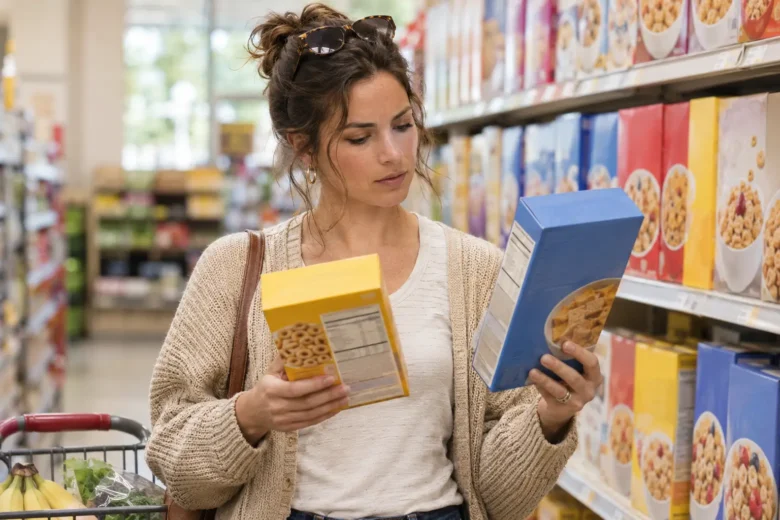
Two cereal boxes each list 4 grams of fiber. One lists that amount for 30 grams of cereal, and the other lists it for 40 grams. If you pour the same weight from each box, you’ll get more fiber from the first cereal. The difference is easy to miss because the number next to “Dietary Fiber” looks identical.
To read a U.S. Nutrition Facts label, start with the serving size, then check how much you’re actually eating. If you’re choosing between two products, compare the nutrients in an equal amount of each. Here’s how to do that with cereal, plus an example for a package you might eat all at once.
Compare two cereal labels side by side
These are fictional examples. The table shows selected values for dry cereal as sold. Milk, yogurt, and other toppings are separate.
| What the label shows | Cereal A | Cereal B |
|---|---|---|
| Serving size | ¾ cup (30 g) | 1 cup (40 g) |
| Calories per serving | 120 | 160 |
| Dietary fiber per serving | 4 g | 4 g |
| Added sugars per serving | 6 g | 7 g |
| Sodium per serving | 150 mg | 160 mg |
At first glance, Cereal A appears to have less added sugar and sodium. But its label measures a smaller serving. To compare both at 40 grams, multiply Cereal A’s values by 40 ÷ 30, or about 1.33. Cereal B’s serving is already 40 grams.
| In an equal 40 g portion | Cereal A | Cereal B |
|---|---|---|
| Calories | 160 | 160 |
| Dietary fiber | About 5.3 g | 4 g |
| Added sugars | 8 g | 7 g |
| Sodium | 200 mg | 160 mg |
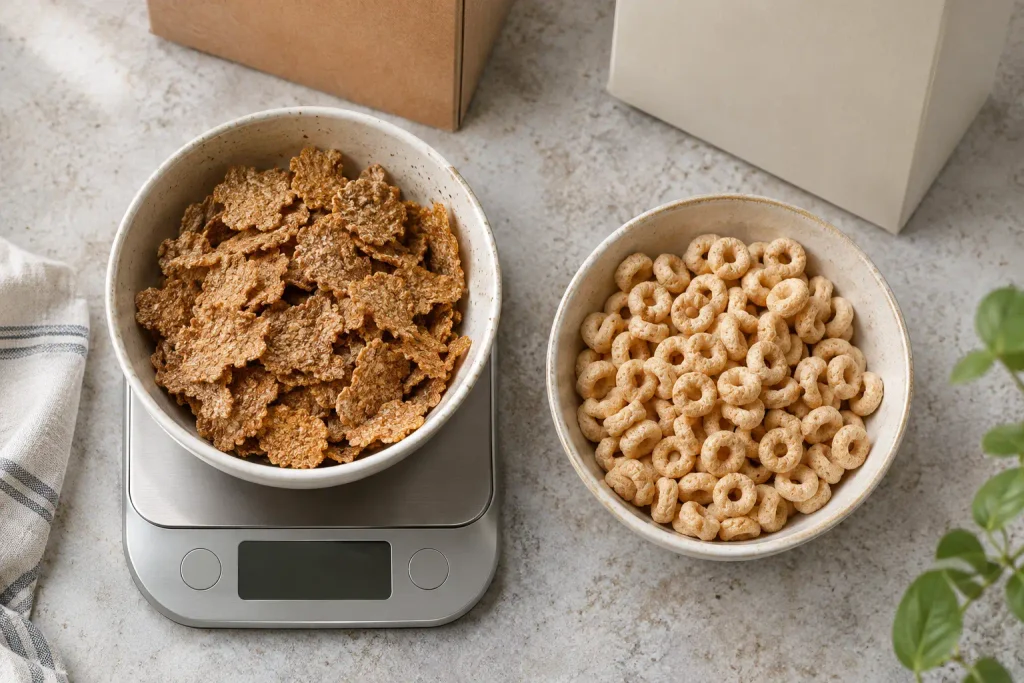
Comparing the same weight of each cereal shows how their fiber, added sugars, and sodium differ.
In the same 40-gram portion, Cereal A provides more fiber, while Cereal B has less added sugar and sodium. If you’re shopping for more fiber, the first comparison points you toward A. If you’re focusing on added sugars, the equal-weight comparison points you toward B. You can use the same calculation for crackers, granola, or any similar products whose labeled servings differ.
1. Start with serving size and servings per container
Look at the top of the Nutrition Facts panel for two lines. Serving size tells you how much food the numbers usually describe. Servings per container tells you how many of those portions the package contains. The serving size reflects an amount people typically eat or drink. Use your actual portion to estimate what you consumed. FDA guidance on serving sizes
If a label lists 1 cup as one serving and you eat 1½ cups, multiply the per-serving calories and nutrient amounts by 1.5. If you eat half a cup, multiply by 0.5. For an equal-weight comparison, use this formula:
Nutrient amount for your portion = amount on the label × (your portion weight ÷ labeled serving weight).
Use the same units for both weights. Compare dry with dry or prepared with prepared. If a label shows figures both as packaged and as prepared, use the column that matches what you’re comparing.
2. Check whether you’re reading per serving or per package
Small packages can contain several servings. Imagine a bag of trail mix with 2 servings per bag, where each serving contains 170 calories, 2 grams of fiber, 5 grams of added sugars, and 90 milligrams of sodium.
| Amount eaten | Calories | Fiber | Added sugars | Sodium |
|---|---|---|---|---|
| Half the bag (1 serving) | 170 | 2 g | 5 g | 90 mg |
| Whole bag (2 servings) | 340 | 4 g | 10 g | 180 mg |
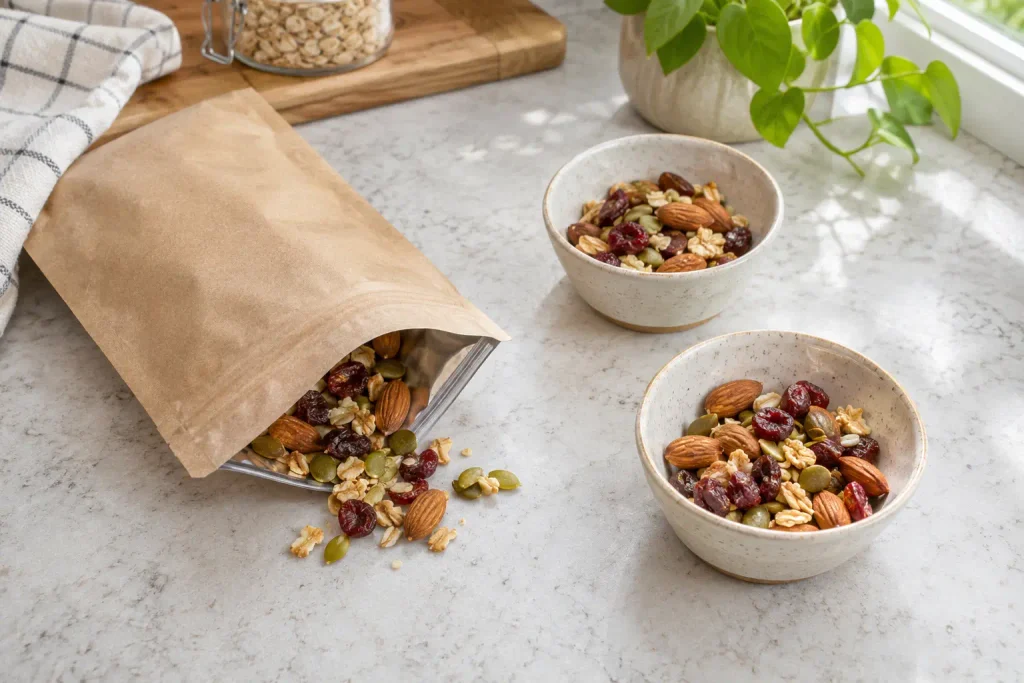
Check the servings per container to see how much you’re eating when you finish the whole bag.
Some packages show two columns, one for a single serving and one for the entire container. If you eat the whole package, use the per container column directly. FDA guidance on reading dual-column labels
3. Use percent Daily Value to put the numbers in context
The % Daily Value, often written %DV, shows how much a serving contributes to the FDA’s daily reference amount for a particular nutrient. The FDA uses 5% DV or less as a guide to a low amount and 20% DV or more as a guide to a high amount per serving. The percentages are general label references. FDA guide to Daily Value percentages
For example, the Daily Value for dietary fiber is 28 grams. A serving with 4 grams of fiber provides about 14% DV because 4 ÷ 28 is approximately 0.14. The grams tell you how much fiber is in the serving. The percentage tells you how that amount compares with the daily reference. If you eat two servings, about 8 grams of fiber would contribute roughly 29% of the Daily Value when calculated from the grams.
Use %DV to scan similar products quickly when their serving sizes match. When the serving sizes differ, compare grams or milligrams in an equal amount first. Remember that a high or low percentage applies to the nutrient you’re looking at. For instance, 20% DV of fiber and 20% DV of sodium answer different questions about the same food.
4. Know which lines to read
| Label line | How to use it |
|---|---|
| Calories | Use the serving size to see how much food the number covers. Include any milk, dressing, or toppings you add separately. |
| Dietary fiber | Compare grams in the amount you typically eat. Start here when choosing between cereals, breads, or crackers for fiber. |
| Total sugars | This line includes naturally occurring sugars and added sugars together. |
| Includes X g Added Sugars | This line shows how much of the total sugar was added. Use it when comparing products such as flavored yogurt or cereal. |
| Sodium | Compare milligrams in an equal portion, especially if you tend to eat a full can or package. |
| Saturated fat | Check grams or %DV for the portion you eat. This can help when comparing similar products such as frozen meals. |
For example, a yogurt label that lists 12 g Total Sugars and Includes 5 g Added Sugars has 12 grams of total sugar, including the 5 grams that were added. The two lines describe overlapping amounts. Total sugars have no %DV on the U.S. label. The %DV beside added sugars applies to the added amount. FDA explanation of total and added sugars
If you’re choosing cereal for fiber, check the label on the cereal you actually buy. For ideas that also use foods such as fruit, oats, and seeds, see High-Fiber Breakfast Foods: 7 Everyday Options and Simple Ways to Use Them.
What to check on your next grocery trip
- Pick two similar products and find the serving size in grams.
- When the serving weights differ, compare the products at the same weight or at the amount you’d actually eat.
- Check the two or three nutrients that matter for the decision you’re making.
- If you expect to eat the full package, check how many servings it contains or use the per-package column when available.
Try this once with two products you buy regularly. After you’ve compared a pair, you’ll know which lines to read the next time you’re standing in the aisle.
Frequently asked questions
Should I compare by cups or by grams?
Grams are useful when you want to compare the same weight of two foods. Two cereals may fill the same cup but weigh different amounts. If you usually eat a cup of either cereal, compare what each label provides for one cup instead. Choose the comparison that matches how you plan to use the food.
Is 20% Daily Value the same as 20% of the package?
The %DV expresses a nutrient amount relative to its daily reference. For instance, 20% DV for sodium means that the amount shown in that column provides about one-fifth of the daily reference for sodium. The column heading tells you whether that percentage is for a serving or for the whole container.
How do I read a label when I eat half a serving?
Divide the listed calories and nutrient amounts by two. For a serving with 160 calories and 4 grams of fiber, half provides about 80 calories and 2 grams of fiber. The same approach works for other fractions of a serving.
About the Author

Manoel Lages is responsible for the editorial content at Virtudes Digital. He writes educational articles on nutrition and everyday well-being, drawing on public health guidance and published research to explain how readers can apply the information in everyday decisions. Learn more about Manoel and the site’s editorial approach on the About Us page.
References
- U.S. Food and Drug Administration. How to Understand and Use the Nutrition Facts Label. Accessed November 27, 2026.
- U.S. Food and Drug Administration. Serving Size on the Nutrition Facts Label. Accessed November 27, 2026.
- U.S. Food and Drug Administration. What’s on the Nutrition Facts Label. Accessed November 27, 2026.
This article is for general education. Consult a qualified healthcare professional for individualized nutrition advice.